The Original Redhead
On Sarah Newmeyer and Inventing the Modern: Untold Stories of the Women Who Shaped The Museum of Modern Art

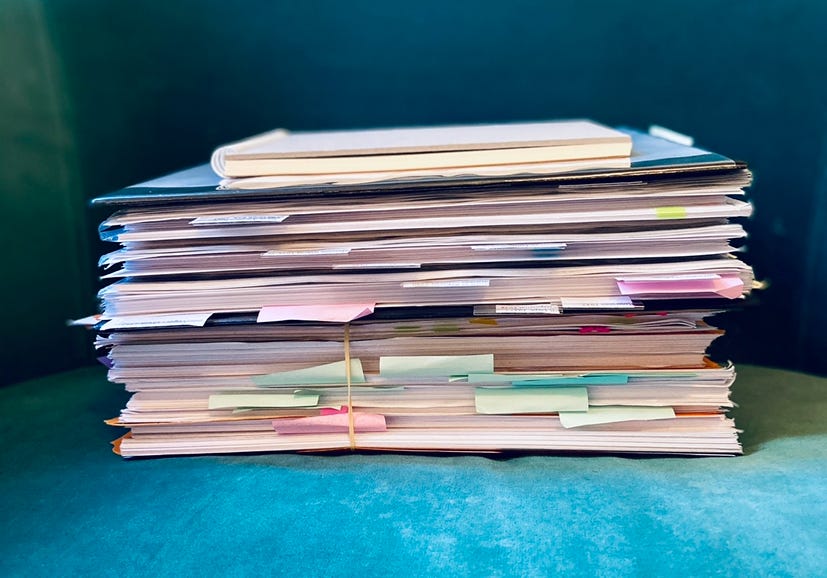
During the pandemic, while I was working on Grief Is for People, an uncannily parallel project came my way, via MoMA. The museum was putting together its own collection of biographies about the women who founded the museum (the gender disparity is pronounced; hence the book), called Inventing the Modern. Most of the women had been written about at length already or were just well-known, with surnames like “Rockefeller.” Sarah Newmeyer, the museum’s fascinating first publicist, was the odd woman out. I had never written a biography of anyone before, of any length. I didn’t realize what I was getting into when I agreed to take on Sarah, or that I would be the first (and probably last) to speak for a whole woman. But I began to realize it when an archivist from MoMA showed up at my apartment with a five-pound mound of Sarah’s correspondence.
I spent a year with Sarah, not reading about her because there was nothing to read, but reading everything she wrote (including a somewhat goofy art book). I saw so much of Russell, the subject of Grief Is for People, and maybe even myself in her. I fell in love with her passive-aggressive intraoffice memos, her passionate retorts to the society ladies who took issue with her, her “screaming matches” with artists, her hilarious drama with Brancusi’s Bird in Space. My heart broke over her wild and tragic death. The following is pretty gross for a writer to type about her own work, but I found myself getting disproportionately emotional while typing the last paragraph. Or, well, the emotion was in proportion to someone else. Either way, it was an honor to bring Sarah to life, to write a little bio (it’s about 5,000 words) for her. I like to think we’d be friends, but who knows…she was petrifying.
So here she is. The book was published last year and is filled with great museum and New York lore from authors and academics alike: Inventing the Modern.
Sarah Newmeyer (1892-1955)
In his day, writer and literary critic Edmund Wilson was so besieged by professional requests that, weary of their monotony (the panels, the questionnaires, the prize-judging), he had stationery printed with the words “Edmund Wilson regrets that it is impossible for him to . . .” This was followed by a checklist of disagreeable tasks such as “read manuscripts” and “supply photographs of himself.” In reading through the papers of Sarah Newmeyer, The Museum of Modern Art’s first publicist, I wondered if Mr. Wilson ever crossed paths with Ms. Newmeyer. They were contemporaries who lived in the same city and cared deeply about culture from different angles—he created it, she spoke for it. I like to think they were at least in the same room a few times, perhaps mutually avoiding Dorothy Parker at the nearby Algonquin Hotel.
As I combed through Newmeyer’s correspondence from her fifteen years as the Museum’s outspoken mouthpiece, I found myself designing some Wilsonesque stationery for her. It would read “Sarah Newmeyer has had it up to here with . . .” This would leave plenty of space for her diatribes about the artists, media, trustees, and interdepartmental drama that irked her. I suspect such a gift would have pleased her. Maybe I’d be lucky enough to get a Newmeyer nickname of my own in return, like “babes” or “glasses”—the kind she routinely came up with for Museum colleagues, regardless of their position (in one letter, she addresses the trustee and collection advisor James Thrall Soby as “bifocals”). “Thanks, babes.”
Newmeyer was born in Memphis in 1892, the eldest of five children (no surprise there, she was a natural when it came to running the show). By the time she was five years old, the family had moved to Cleveland, but by her late twenties she, her parents, and two of her brothers had relocated to the Bay Area, where the family remained. Newmeyer spent some amount of pre-MoMA time in New York, living at the famed Barbizon Hotel, but by age forty, she was back in California, writing “sentimental fiction for popular magazines,” according to Russell Lynes’s 1973 survey of the Museum’s history. She came from a theatrical family and had playwriting ambitions, and found some success. In 1932 her play License (originally titled The Love Lease) was staged to critical acclaim at a theater in Berkeley. Broadway titan Jed Harris had bought the play the previous year, though it was never produced. It wasn’t until 1939, while working at MoMA, that Newmeyer would experience the sensation of a dual career, when one of her plays, Susanna Don’t You Cry, was produced on Broadway.
Meanwhile, in 1933, The Museum of Modern Art, then only four years old, had tapped Newmeyer to become the director of its new Publicity Department, one of the first departments of its kind in an American museum. And Newmeyer was one of the first women in the field. Period. How, exactly, she came to the Museum’s attention remains a mystery. Her only salaried work stints at that point were as a teacher and a secretary. It’s very Sarah Newmeyer that she seems to have simply manifested.
A “publicity department” was an ambitious innovation for the nascent institution. Yet the powers that be at MoMA recognized the importance of assertive outreach early on. Already in 1930, Abby Rockefeller, one of the Museum’s three founders, had given Alfred H. Barr Jr., MoMA’s first director, $5,000 to commission a report advising the Museum on how to implement its first fundraiser and membership drive. To write the report, Barr hired Edward Bernays, the public relations pioneer who was influenced by ideas regarding the subconscious posited by his uncle, Sigmund Freud. Starting in 1931 the Museum employed the generalized services of an outside press agent to drum up publicity, and information about the Museum’s activities was distributed to some two hundred publications. Thus even before Newmeyer’s appointment, MoMA had developed a modest way of garnering attention. But it had become increasingly clear that this would not suffice; they needed someone on the inside. Someone with . . . flair.
No mention of Sarah Newmeyer is complete without a nod to her hair. Lynes described her as “redheaded and exploding with ideas.” The headline of a 1947 profile on her in the Saturday Evening Post read “The Museum and the Redhead.” Newmeyer resembled a slightly stockier Bernadette Peters with a more formidable collection of hats. She’d blow through the office every morning wearing one of them, always a little late and a little frazzled. Not lacking in a sense of humor, Newmeyer would joke, “I’m as beautiful as Greta Garbo.” Descriptors like “bold,” “shrewd,” “a character,” and the occasional “hysterical” attached to her like barnacles.
It was during her early years at the Museum that she did some of her most innovative work. Although Newmeyer doesn’t appear to have had any formal training or experience working in publicity, she did have a passion for contemporary art and art history, as well as the fundamental qualities that make a good publicist: articulation and vision. She was also not afraid to marshal her creativity to hound members of the press. This was at a time when “museums spoke in hushed whispers, not shouts” as Alice Goldfarb Marquis put it in her biography of Barr. Newmeyer’s press releases incorporated the curatorial copy but did so with an uncommon eye for the dramatic. She staged events tailored for the press and had a knack for recognizing when to transform an otherwise commonplace occurrence into a scene worthy of reporters or a film crew. She also started getting the Museum mentioned in the society pages as well as in the arts ones, steering it beyond the specialized readership of art criticism. This was met with ambivalence in the more conservative social circles affiliated with the Museum (these were the types who subscribed to the belief that a lady’s name should only appear in the newspaper twice, at birth and at death).
But Newmeyer cared not. She dreamt up radio and television broadcasts and devised the “Artist as Reporter” contest, inspired by Winslow Homer, who got his start not on the walls of a gallery but in the pages of Harper’s Weekly. To her, the Museum was not just a place to house art but a tool with which to broaden the public’s imagination. Her tactics worked: by 1938 the number of clippings about the Museum taken from newspapers and magazines across the country was more than double the number in 1932 and within a couple of years, Newmeyer had increased the number from two hundred to over one thousand. Newmeyer’s contribution to the Museum’s success in its earliest years is unquestionable. And yet, unlike other Museum luminaries, this is surely the first time you’re reading her name. It is a truth universally acknowledged that arts publicists are unheralded. Internally, they tend to come on board to a project too late to be thanked in the programs or the closing credits or the acknowledgments pages. Externally, things aren’t much better. They’re considered pesky, of inferior intelligence to their more rarefied coworkers (directors, curators, conductors, editors), and are sometimes uninformed about the very product they’re pushing. But Newmeyer was none of those things. Well, “pesky.”
Her first publicity coup began before she’d even unpacked her office. En route to her new gig in New York, she stopped at the Chicago World’s Fair, where she saw James McNeill Whistler’s 1871 painting Arrangement in Grey and Black No. 1, better known as Whistler’s Mother, on display as part of an eighteen-month tour. The portrait, then part of the collections at the Musée du Louvre, in Paris, was traveling the country courtesy of MoMA, which had brought it to New York the previous October for the exhibition American Painting and Sculpture, 1862–1932. Whistler’s painting proved so popular with audiences that the Museum arranged to extend the loan, dispatching the picture on a cross-country tour.
On seeing Whistler’s Mother in Chicago, Newmeyer observed zero mention in the signage or curatorial materials that the painting was on loan from the Louvre. Or, more to the point, that MoMA was responsible for bringing it to America in the first place. By the time she got to her desk at the Museum, she was “hopping mad.” And one did not want to be around Sarah Newmeyer when she was mad, hopping or otherwise. William S. Lieberman, the Museum’s longtime curator who started at MoMA in 1943, put it plainly: “She scared the shit out of me.”
Newmeyer went on the warpath to make sure Whistler’s Mother and the Museum were associated from then on. Each time the painting departed for a new venue, Newmeyer sent out a flurry of press releases nationwide, announcing the upcoming journey. Tuned into the country’s evergreen fascination with expensive art, she told the press that the Louvre valued Whistler’s Mother at $1 million, although MoMA eventually negotiated a premium of half that amount. She seemed to have a kind of uncanny awareness of the appeal of the museum heist and wrote at length on the rigorous security measures that shadowed the painting wherever it went—the police escorts, the armed guards, the secret alarms. She arranged for front-page stories reporting on the painting’s arrival in city after city. Governors and mayors showed up to have their picture taken with it. In May 1934, when the United States Postal Service issued a stamp featuring Whistler’s Mother, Newmeyer circulated a letter from Barr excoriating the postmaster general for adulterating the original composition by adding a vase of flowers to its lower-left corner. She even convinced a reluctant Sara Roosevelt, mother to President Roosevelt, to pose with the portrait when it returned to the Museum. Newmeyer proved that an art show could be an extravaganza, not just an aesthetic display.
Marquis refers to the “orgy of publicity” surrounding Whistler’s painting and observes that while Barr “later deplored all the hoopla and claimed no hand in ‘the excessive popular interest” in the work, he could not deny its success. Internally, Newmeyer became known for her publicity stunts, which extended beyond her initial successes with Whistler’s Mother. In 1934 she helped to devise a “beauty contest” for the industrial objects on display in the newly opened exhibition Machine Art, roping in celebrity judges such as Amelia Earhart and John Dewey. Newmeyer’s celebrity radar was also at work on a winter afternoon in 1935 when Albert Einstein showed up just as the Museum was closing. Newmeyer insisted on keeping the lights on and security present for as long as he wanted to stay . . . and used the time in between to phone the New York Times and Herald Tribune. In January 1940 she lit the Museum exterior with floodlights so that news cameras could record the high-security arrival of twenty-eight works by Italian Renaissance greats, among them Botticelli’s Birth of Venus.
By making noise when others were afraid to, she was perpetually out of step with the rarified world of trustees and wealth. And yet, for the fledgling museum trying to eke out a name for itself in America’s imagination? She was exactly what they needed. Newmeyer was essential to the production of a broadcast radio program called Art in America (1934–35), which was supported by the American Federation of Arts and the Carnegie Corporation, and headquartered at the Museum. The series was innovative for its unique amalgam of education and entertainment and for its use of mass media to reach a general audience. It was also likely the first national radio broadcast on the arts. In seventeen episodes, Art in America considered important aspects of American art from the time of the Civil War to 1934. Newmeyer managed the broadcast and wrote the scripts, using an illustrated guide to the series that was authored by MoMA curators and various outside experts. Harnessing her skills as a playwright, she formatted most of the installments as conversations between an expert and a layperson. (“Q: Has there been any change in the style or method of American sculpture in the past few years? A: “The best sculptors today have a genuine feeling for the material they work in. Instead of using granite as they would marble, they give granite or other stone the treatment that will bring out its essential qualities: its hardness and resistance, its weight, grain, and color.”) To promote the broadcast, as well as make it accessible, Newmeyer assembled the weekly Art in America News, which featured an image accompanied by an episode summary that she herself wrote.
But perhaps the greatest triumph of Newmeyer’s career, her darling of darlings, was Barr’s van Gogh exhibit in 1935. More than one hundred oils, watercolors, and drawings hung alongside excerpts of van Gogh’s letters to his younger brother, Theo. Barr’s curatorial imagination laid the table for the show’s unprecedented adulation, but Newmeyer brought it home, ensuring all the guests turned up. The American public was primed for van Gogh’s arrival, his popularity having grown steadily over the previous decade and having been given a boost with the back-to-back publication of a biography (1933) and a biographical novel (1934). Surprisingly the Museum’s Advisory Committee had initially opposed the exhibition, counting what they believed to be the artist’s waning influence among their objections.
To ensure the show’s success, Newmeyer used tactics sourced from the playbook she’d established with Whistler’s Mother. She did almost too good a job. An initial press release stressed how difficult it was to borrow the van Gogh artworks; how far they’d sailed to get there; how expensive their valuation (collectively $1 million dollars). In a subsequent release she once again boasted about a Roosevelt-related visitor—this time his wife, Eleanor. Newmeyer was likely responsible for the announcement banner that hung from the Museum’s façade, which irked a local merchants’ association. Admission was twenty-five cents (the rough equivalent of a movie ticket) and when the lines snaked down the street and around the corner, Newmeyer had the press come take pictures. The exhibition rooms grew so crowded, the police were summoned to control the flow of visitors into the building. The show was the subject of countless articles, including the lead editorial in the New York Herald Tribune. According to A. Conger Goodyear’s The Museum of Modern Art: The First Ten Years, coverage was so intense, there was a “nation-wide eruption of printer’s ink.” Newmeyer made every effort to, in her words, “emphasize his art and not his ears.” Unsurprisingly, the press did not. Still: “We played the Van Gogh show like a polo game,” Newmeyer recounted, “dribbled the ball down the field first, and then, bang, right between the goal posts! It was a honey, if I do say so myself.”